The Book That Built Clarence Thomas
A sitting Supreme Court Justice walked onto a Texas stage, read progressivism's criminal record into the public record, and cited Thomas Sowell by name. Here is the man who built him.
Clarence Thomas has been playing dead since 1991.
Last week at the University of Texas, he stopped and he cited Thomas Sowell while doing it.
He walked up to a lectern, adjusted the microphone, and read the progressive movement's criminal record into the public record.
Stalin. Hitler. Mussolini. Mao.
Eugenics. Forced sterilization. Woodrow Wilson's resegregation of the federal civil service.
He named them all.
He said these men were "intertwined with the rise of progressivism." He said American progressives "expressed admiration for each of them shortly before their governments killed tens of millions of people."
Then he cited Thomas Sowell by name. Used Sowell's phrase: "visions of the anointed."
And he closed with a word that should end a century of progressive marketing.
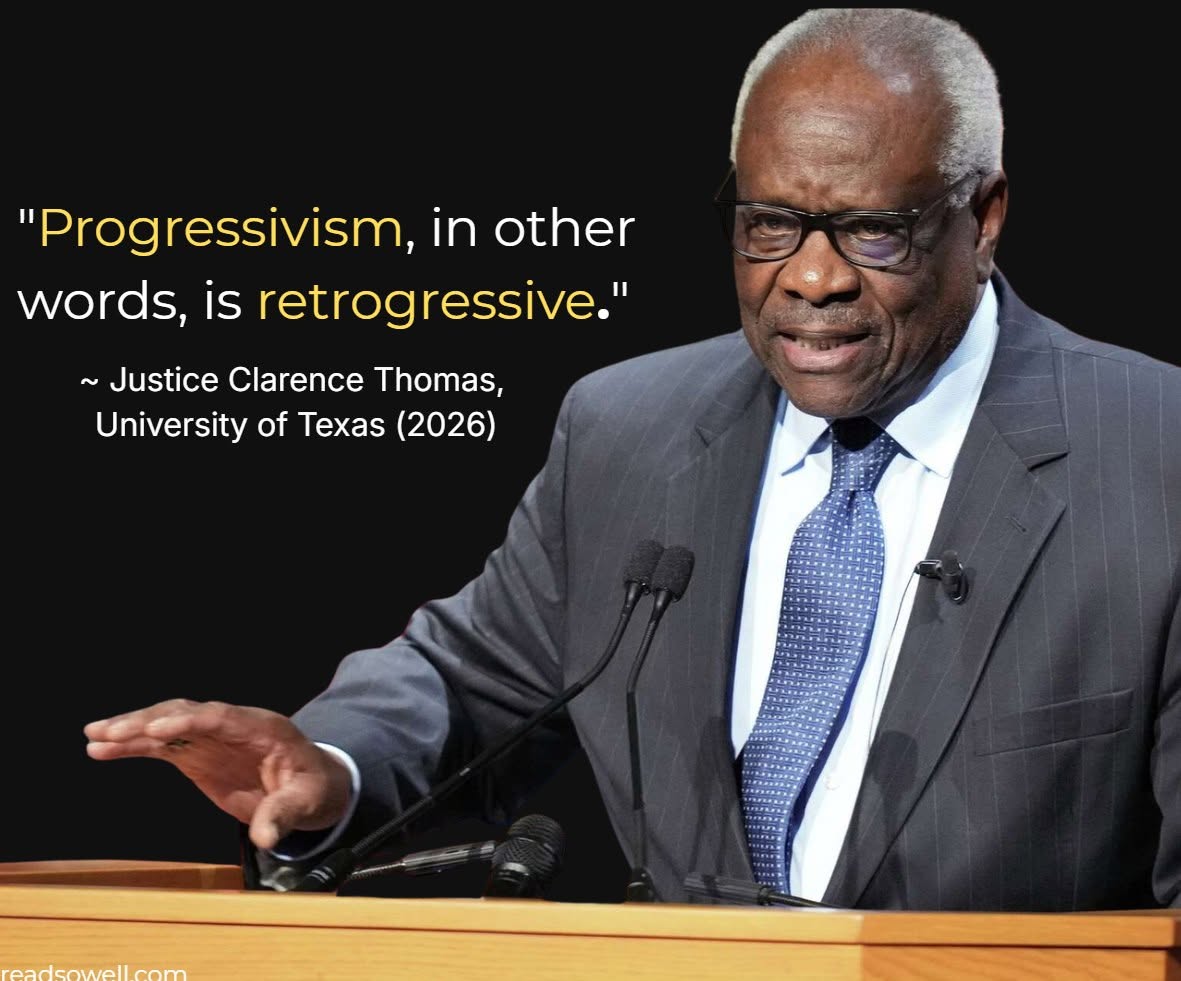
"Progressivism," he said, "is retrogressive."
Now ask yourself something.
Why is a sitting Supreme Court Justice saying this now? In 2026? Not in 1995. Not in 2005. Not in 2015. Why now?
To answer that, you have to go back. Sit back, get comfortable, maybe grab your favorite beverage. I'm going to tell you a story you're never going to forget.
In 1991, George H.W. Bush nominated a black American lawyer named Clarence Thomas to the Supreme Court. What happened next is one of the ugliest confirmation proceedings in American history.
The man who presided over it was Senator Joseph R. Biden.
Yes. That Joe Biden. Sleepy Joe. The President who couldn't form coherent sentences and kept wandering off stages.
This was 1991. He was younger. Sharper... but only a little. He was already the Senate Judiciary Chair with ambition bigger than his capability, and a reputation for turning hearings into spectacles.
Biden chaired the hearings. He let the Anita Hill allegations run. He turned the Senate Judiciary Committee into a prime-time spectacle of a black conservative being dismembered in public. It was brutal. You can watch it on YouTube today.
Thomas didn't flinch.
Looking the committee in the eye, he said it for the record:
"This is a circus. It's a national disgrace. And from my standpoint as a black American, as far as I'm concerned, it is a high-tech lynching for uppity blacks who in any way deign to think for themselves."
He was confirmed 52-48. The narrowest margin in over a century. By the skin of his teeth.
For the next 35 years, the establishment tried everything else.
Joe Biden, the man who chaired the hearings, went on to become Vice President. Then President. Along the way he told a black audience that voting Republican meant being "put back in chains." Harry Reid called Thomas "an embarrassment to the Supreme Court." In 2023 and 2024, ProPublica ran a campaign designed to force his recusal through ethics revelations that Democratic senators then used to call for impeachment. Dahlia Lithwick wrote hostile Thomas coverage for Slate across three decades. The New York Times quoted him selectively and hostilely. Late-night hosts made him the butt of jokes. Op-ed columnists called him "Uncle Tom" so often the slur stopped being shocking...
and he wrote...
and he waited...
and he watched...
He wrote concurrences. He wrote dissents. He wrote footnotes that cited Thomas Sowell and Frederick Douglass and the Founders in a tradition his peers treated as embarrassing. He asked almost no questions from the bench for ten years. Journalists called him lazy. Activists called him a sellout. Legal scholars wrote his obituary before he'd finished writing his dissent.
and he kept writing...
he kept waiting...
he kept watching...
Ask yourself: what does it take to endure that? To stay silent from the highest court for 35 years while every cultural organ in the country tells you you're illegitimate? To bury every humiliation and keep writing?
I'll tell you what it takes.
It takes patience most men will never possess.
And it takes a book.
In 1975, before any of this, a young angry black man named Clarence Thomas opened a book called Race and Economics. He'd been drifting left his whole life. Reading the Marxists, pretending to be a revolutionary... Then he read this book, and just like that... he stopped pretending, forever.
The book was by Thomas Sowell.
Here is what you need to understand:
Thomas Sowell is not famous the way Clarence Thomas is famous. Sowell has never worn a robe. He was not the target of cable news hearings. He did not become a Supreme Court Justice.
Sowell is something harder to name.
He is the man who wrote the book that built the man who just fired the shot at the University of Texas.
Sowell wrote in 1993: "It is amazing how much panic one honest man can spread among a multitude of hypocrites." He was describing the man Clarence Thomas would become.
And he built others. Thousands of them. Economists. Judges. Journalists. Fathers. Teachers. Writers. Soldiers. The occasional Supreme Court Justice. Quietly. Over six decades. From a desk at the Hoover Institution at Stanford, a corner of dissident infrastructure the cathedral never fully captured, he wrote book after book that most of America will never read. Their ideas shaped a generation of minds that refused to be broken.
Sowell was born in 1930. Gastonia, North Carolina. His father died before he was born. His mother died when he was young. He was raised by a great-aunt in Harlem. High school dropout. Homeless at seventeen. Marines during Korea. Then Howard. Then Harvard. Then a master's at Columbia. Then a PhD at Chicago, studying under Milton Friedman and George Stigler.
Stop and read that again. Harlem homeless teenager, to University of Chicago under two future Nobel laureates. Those aren't supposed to be the same person.
And then sixty more years of tireless work.
He never chased celebrity. He refused every role the establishment offered. He never became the black intellectual the progressive priesthood wanted him to become. He became something they'll never forgive him for: a man whose life disproves their entire business model.
And he kept writing...
And here is the thing about Clarence Thomas at the University of Texas last week.
He wasn't alone.
Something has been shifting for the last couple of years. Trump back in office. DEI in retreat across corporate America. Ethics investigations against conservative Justices collapsing without consequence. The cultural enforcement apparatus that worked in 2017 doesn't work anymore. The establishment's power to punish dissent is measurably weaker than it was five years ago.
Clarence Thomas is not a reckless man. He waited for this. His speech at UT isn't a solo. It's the senior heretic speaking now that the punishment apparatus can't match his standing. Like a predator who has identified the perfect opportunity to strike.
Last week he decided the waiting was over.
The speech is the evidence, the calculation is the story.
We are in a different moment than we were six months ago. You can feel it, right? Things are moving fast.
The predator was prey. The prey was patient. The patience just ended.
And the man who inspired him is still here.
Thomas Sowell is 95 years old. A Supreme Court Justice just cited him by name on a university stage while explaining why progressivism produced the mass graves of the twentieth century.
Now ask the question that matters.
Is there an audience for this?
Look around. Hundreds of Sowell quote pages across Facebook. Thousands of YouTube clips in circulation. Millions who have his books on their shelves. This page alone, which I've run for ten years, has 184,000 followers and tens of millions of impressions every month. Others have more.
The populist energy is there. It's been there for decades.
Sowell's readership has the same shape Martin Luther King's movement had at its peak. Organic. Cross-generational. Hungry. Mobilizable.
The question is whether the right has the discipline to harness it.
Martin Luther King defined an era. Whatever you think of his politics, his movement took his ideas and carved them into the America that came after him. His people claimed him. They built around him. They made his words into political architecture. They did what a movement does when it decides to make a man into a monument.
Thomas Sowell has the same gravitational mass. Different politics. Same shape of readership. Same potential.
A Supreme Court Justice just proved it. The fans are there. The ideas are there. The moment is here.
So here's the question that matters now:
Will the right have the discipline to do what MLK's people did?
Do we have it in us?
Will we claim Sowell as our own?
Or will we squander the legacy these men built?
Sowell won't be on this earth forever.
When he drops the torch, someone has to catch it. Or we lose it.
That depends on us.
Sowell fought this battle for sixty years. Clarence Thomas just fired the first shot of a new phase of it from a university stage in Texas.
If we let the work drift after he's gone, the priesthood finishes the rewrite. The wrong people write the textbooks. The wrong people tell your grandchildren the twentieth century's mass graves were unfortunate accidents of progress. The wrong people bury the truth Sowell spent sixty years digging up.
Sowell is a warrior. The war is ours now.
Get up. It's our turn.
Stay close,
Clay
P.S. If this piece meant something to you, you can support the writing here: ReadSowell.com/support-donate
The daily emails go out from here.
Stories like this one. Sometimes harder. The people on the list get the work first.
No spam. No algorithm. Unsubscribe anytime.